
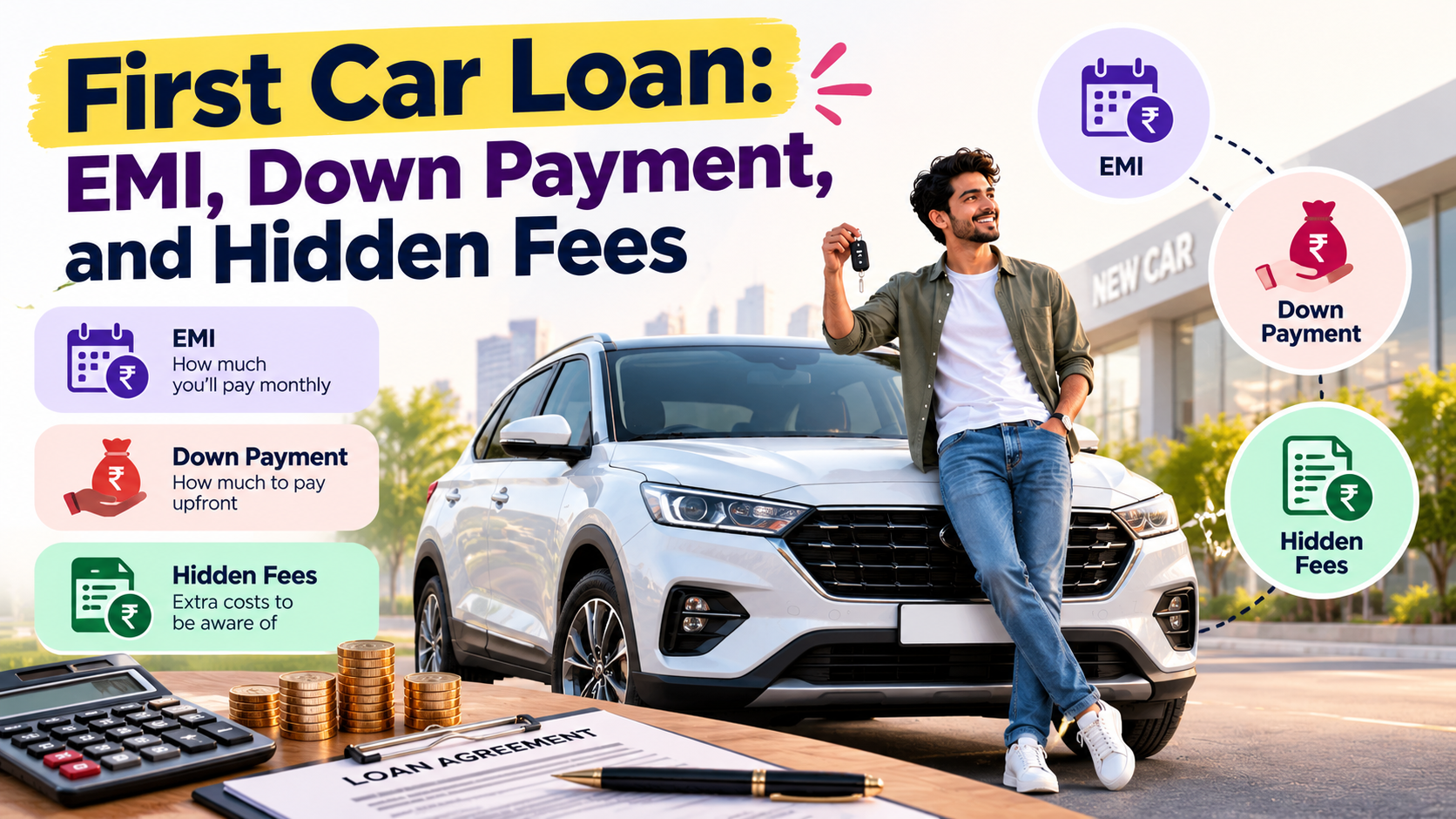
Having a car of your own can be quite thrilling, but you should know the cost associated with it before purchasing it. Apart from the car's price, you need to consider the car loan down payment, monthly Equated Monthly Instalment (EMI), interest rate and additional charges. Knowing how these costs work can help you choose a suitable first car loan without putting unnecessary pressure on your monthly budget.
1. Understand the Down Payment
A car loan down payment is the amount you pay upfront when purchasing a car. The remaining amount is financed by the lender through a loan.
Acquiring the first car can be an exhilarating experience, but having knowledge of the cost of the loan is very important. For instance, if your car costs ₹8 lakh and you make a 20% down payment of ₹1.6 lakh, then you will require a loan of ₹6.4 lakh.
Making a large down payment will help reduce the cost of the loan and hence your EMI and interest will be low. But you should not put all your savings into buying the car.
2. Calculate Your Monthly EMI
Your car loan EMI depends on the loan amount, interest rate and repayment tenure. A longer tenure generally reduces the monthly EMI but may increase the total interest paid.
For example, consider a ₹6.4 lakh loan at an illustrative annual car loan interest rate of 9%:
Loan Tenure
Approx. Monthly EMI
Approx. Total Interest
3 years
₹20,351
₹92,636
5 years
₹13,286
₹1.57 lakh
7 years
₹10,291
₹2.24 lakh
Prior to selecting the tenure, you should ensure that the EMI comfortably fits into your salary after taking into consideration rent and other expenses.
3. Compare Car Loan Interest Rates
Different banks and financial institutions may offer different car loan interest rates based on your credit profile, income, loan amount, vehicle and repayment history.
When comparing a car loan in India, check whether the interest rate is fixed or floating, how it is calculated, and whether the quoted rate is available to you.
Don’t choose a lender based solely on the interest rate that is offered. Consider the total amount that will have to be paid back and other fees. If you need help making an informed car-buying decision, explore MotorHalt's consultancy services for guidance before purchasing your first car.
4. Watch Out for Hidden Car Loan Fees
Loans can have fees in addition to the amount borrowed and interest charged. Ensure that you request a detailed fee schedule from the lender before accepting their terms.
Common hidden car loan charges to check include:
-
Processing fee: A fee for evaluating and processing your loan application.
-
Documentation charges: Costs associated with preparing or handling loan documents, where applicable.
-
Foreclosure or prepayment charges: Fees that may apply if you repay the loan early, depending on the contract and applicable rules.
-
Late payment charges: Additional costs for missing an EMI deadline.
-
Penal charges: Charges that may apply for specified loan defaults or breaches.
-
Other applicable fees: Ask about any valuation, mandate or administrative charges not included in the initial quote.
Ask for the Key Facts Statement (KFS) from the lender, wherever applicable, and look into the Annual Percentage Rate (APR) or cost information stated. This will give you an idea about the total cost of borrowing instead of just the EMI.
5. Check Your Credit Score Before Applying
Your credit history can influence car loan eligibility and the interest rate offered. Before applying, review your credit report for errors and pay existing EMIs and credit card bills on time.
Do not submit many applications until you compare them. Moreover, only borrow what is possible to repay. Do not try to stretch the budget for a costlier one.
6. Choose a Comfortable Repayment Tenure
Your car loan repayment tenure affects both your monthly EMI and the total interest you pay. A shorter tenure usually means higher monthly payments but lower overall interest, while a longer tenure can make EMIs more manageable.
Consider various modes of repayment before taking the decision. Select tenure which ensures low monthly installments as well as total borrowing cost.
7. Budget for Costs Beyond the Loan
Monthly expenditure on your car would not be only the EMI amount but also the cost of fuel, insurance, service charges, parking charges, repair charges, etc.
If you are purchasing the car for the first time, then the comparison of the overall purchase cost will be as equally significant as the comparison of the various loans.
Conclusion
Before taking your first car loan, calculate your down payment, compare car loan EMI options across different tenures and check every applicable fee. Review the car loan interest rate, repayment conditions and total borrowing cost before signing the agreement. A well-planned car loan in India should help you purchase a car while leaving enough room in your budget for everyday expenses and unexpected costs.